.jpeg)
Italy’s most successful 20th century sculptor, with an international profile similar to his British contemporary and friend Henry Moore, Marino Marini also had a significant body of paintings and graphic work.
“I never start a sculpture without a pictorial investigation.”
Like Moore, Marini had a small number of near lifelong motifs that he returned to again and again. His greatest fixation, and the theme for which he is best known is the horse and rider. Variations on this theme will feel immediately familiar to anyone who has visited the Guggenheim in Venice, where Marini’s Angel of the City is the only artwork on the terrace overlooking the Grand Canal.
Marini used this motif to explore the human condition, perhaps aiming for something even more fundamental than that with the inclusion of the interconnected horse.
“For we Italians, who are a political nation, an equestrian figure has something of the heroic and romantic about it: an undefinable sensation but one which is always present. Sometimes the riders are sorrowful, or even euphoric, or tragic, above all if man finds himself saddleless. When the rider lives a tranquil context, the horse is calm. When he lives in a restless period, the animal is also disturbed.”
We see these changing emotions and the interrelation between rider and horse through Marini’s career.
There are countless variations through his sculptural and graphic output, often subtle, but sometimes drastic and more obviously in tune with the outside world.
This is most evident in the ‘miracle’ series, a number of works depicting the rider and horse both falling, which Marini commenced after the Second World War.
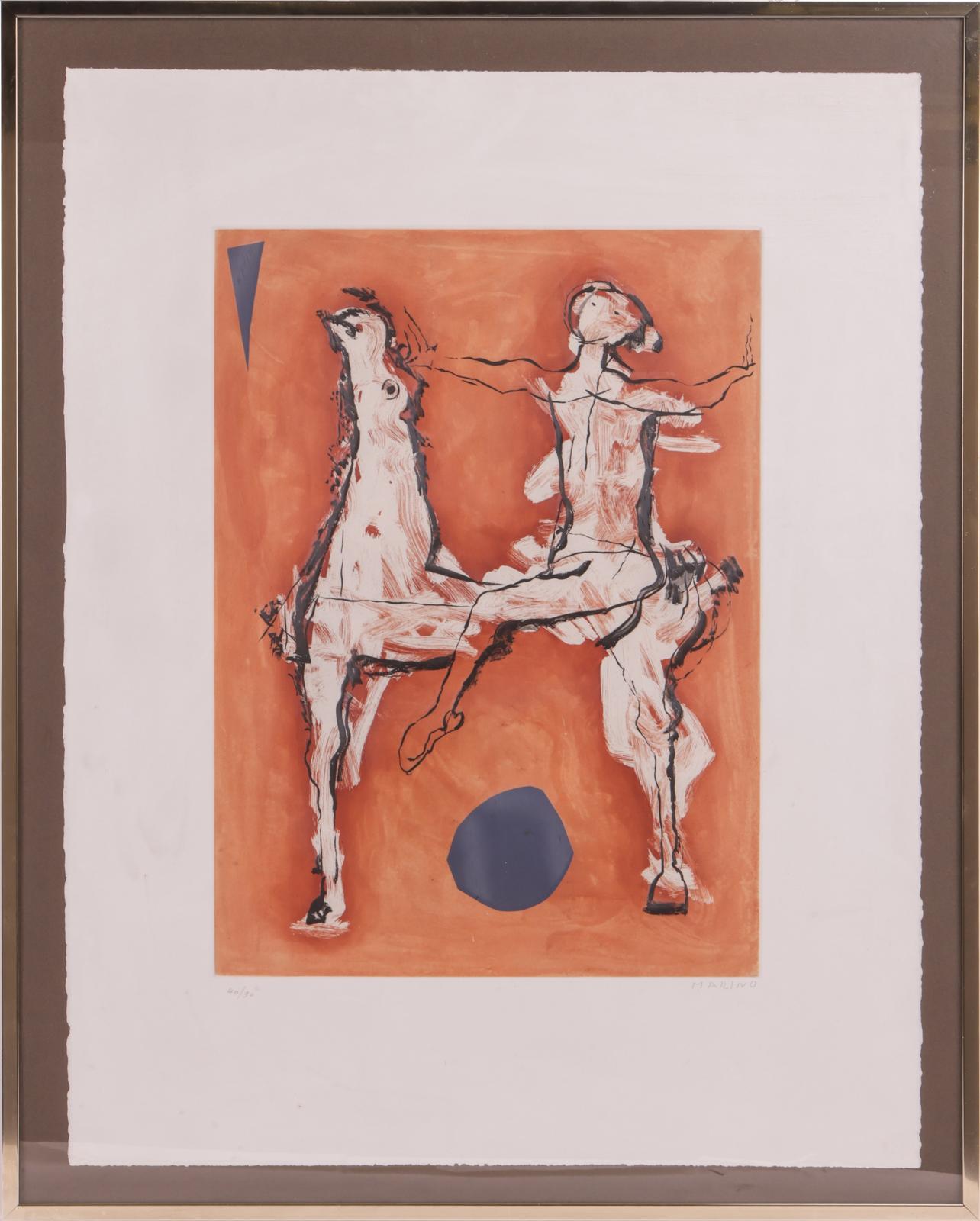
The present work, executed three years before his death, stands as one of Marini’s last ‘cavalieri’.
Notes:
Guastalla A196
Etching and aquatint in colours
On Arches paper
Signed in pencil and numbered 40/90
Printed and published by Atelier Fratelli Crommellynck, Paris, 1977
.jpeg)