In some respects Howard Hodgkin painted like a printmaker, building layer after layer of thin paint to find the end result.
In other respects Hodgkin’s focus on printing was surprising – while painting he was spontaneous in much of his mark making, and he would also sometimes continue to add to paintings for years after their start.
Neither of those characteristics would seem complementary to the planning and disciplined approach typically required for printmaking processes.
This is perhaps why Hodgkin would use hand colouring as a deliberate and primary form of mark making in his prints. Such an approach is unusual, with hand colouring usually only used by printmakers as a corrective act.
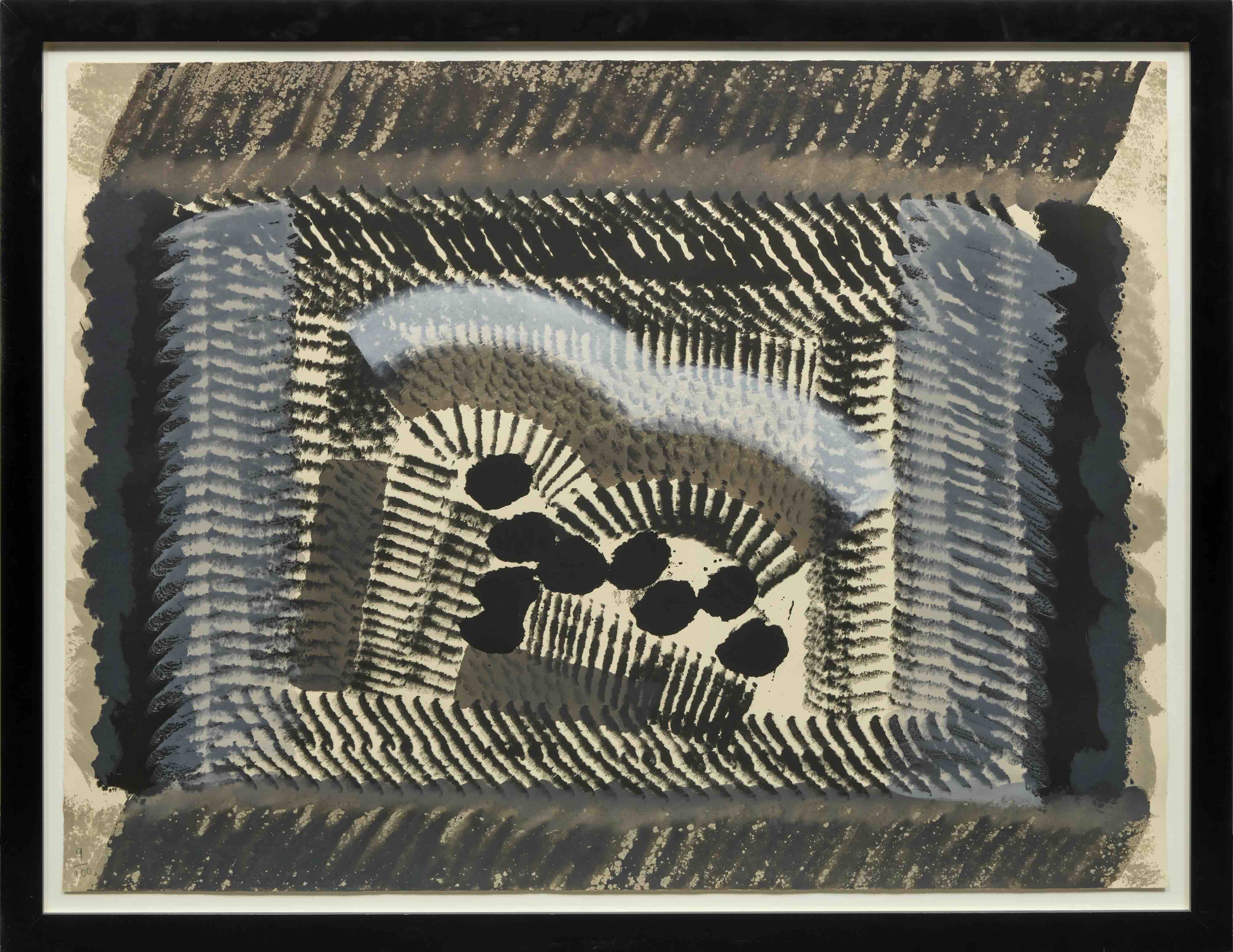
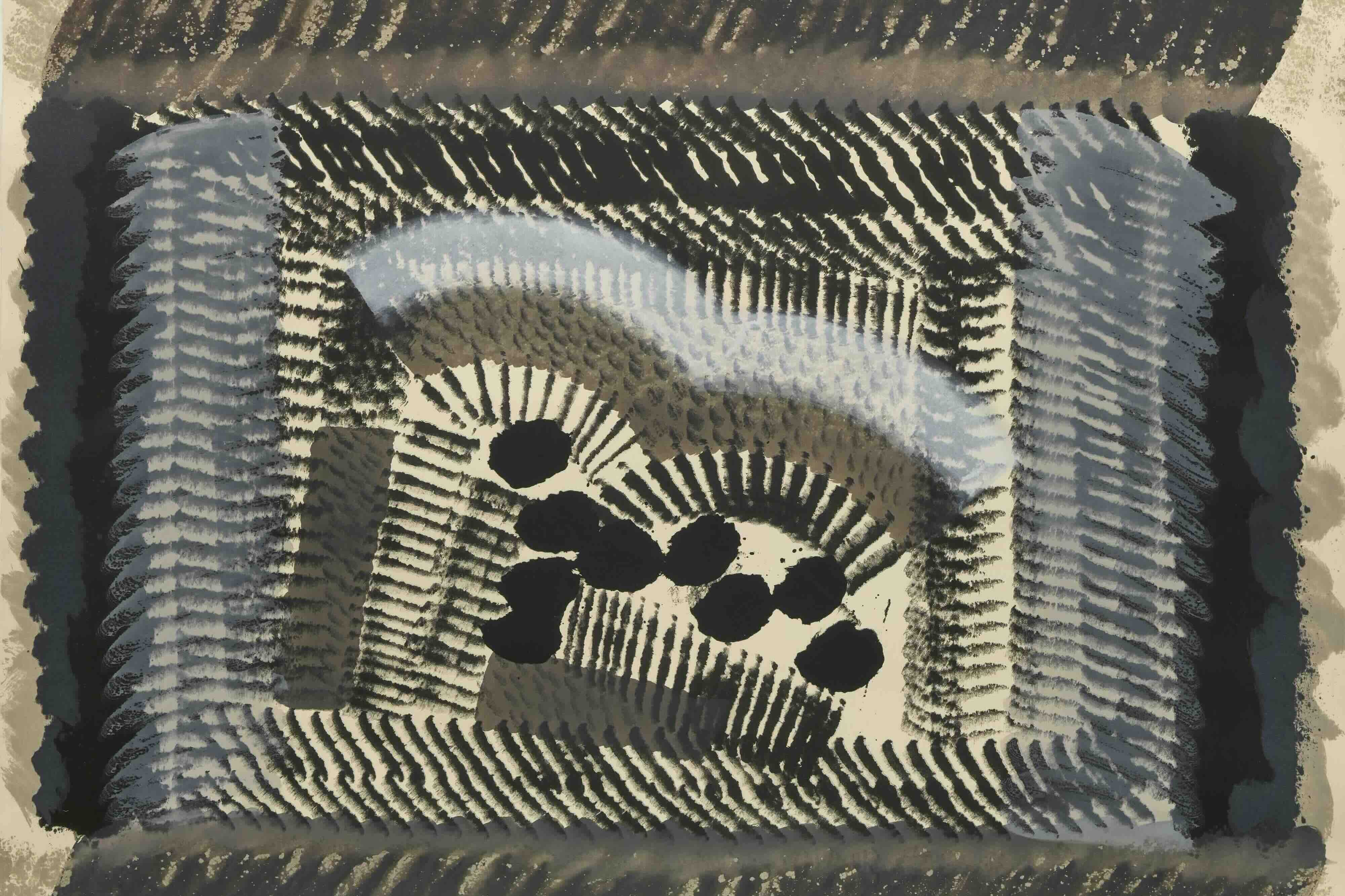
The colours in this work, unusually subdued for Hodgkin who is often heralded as Britain’s greatest 20th century colourist, are applied by printing and hand colouring in gouache.
Hodgkin is also well known for painting onto the frames, making them as much a part of the artwork as the canvas, and in the process removing any choice of framing from others. Along the same vein he did not like the distancing impact of glass, frames and mounts.
The framing of this present work is extremely high quality and has been undertaken with great sympathy to Hodgkin’s views. The simple black frame avoids distraction, and the anti-reflective museum glass allows the work to be viewed as if unglazed while providing vital protection to a large work on paper.
An impression of Two To Go is held by MoMA.
Notes:
Heenk 66
Lithograph from three aluminium plates printed in classic black, transparent grey and velvet black, with hand colouring in gouache (four different greys)
On buff Velin Arches mould-made paper (300 gsm)
Signed with initials and dated 81 in pencil, lower centre
Numbered 9/100 in pencil, lower left
Proofed and printed by Judith Solodkin at Solo Press Inc., New York
Hand coloured by Cinda Sparling, New York
With the Solo Press blindstamp in the lower right and the printer's seal in the lower left
Published by Bernard Jacobson Ltd, London, 1982
Bespoke Darbyshire frame, with anti-reflective and UV-protected museum glass