.jpeg)
In 1968, Henry Moore was gifted an elephant skull by Julian Huxley, biologist and first Director-General of UNESCO. As the captions to his ensuing Elephant Skull album of etchings reveal, the elephant was to Moore 'the most remarkable living link we have with the prehistoric world' and the skull was 'the most impressive item in my library of natural forms'.
Moore drew the skull obsessively, these drawings in turn giving rise to 34 etchings – today some of the best known graphic works of Moore's career.
"By bringing the skull very close to me and drawing various details I found so many contrasts of form and shape that I could begin to see in it great deserts and rocky landscapes, big caves in the side of hills, great pieces of architecture, columns and dungeons."
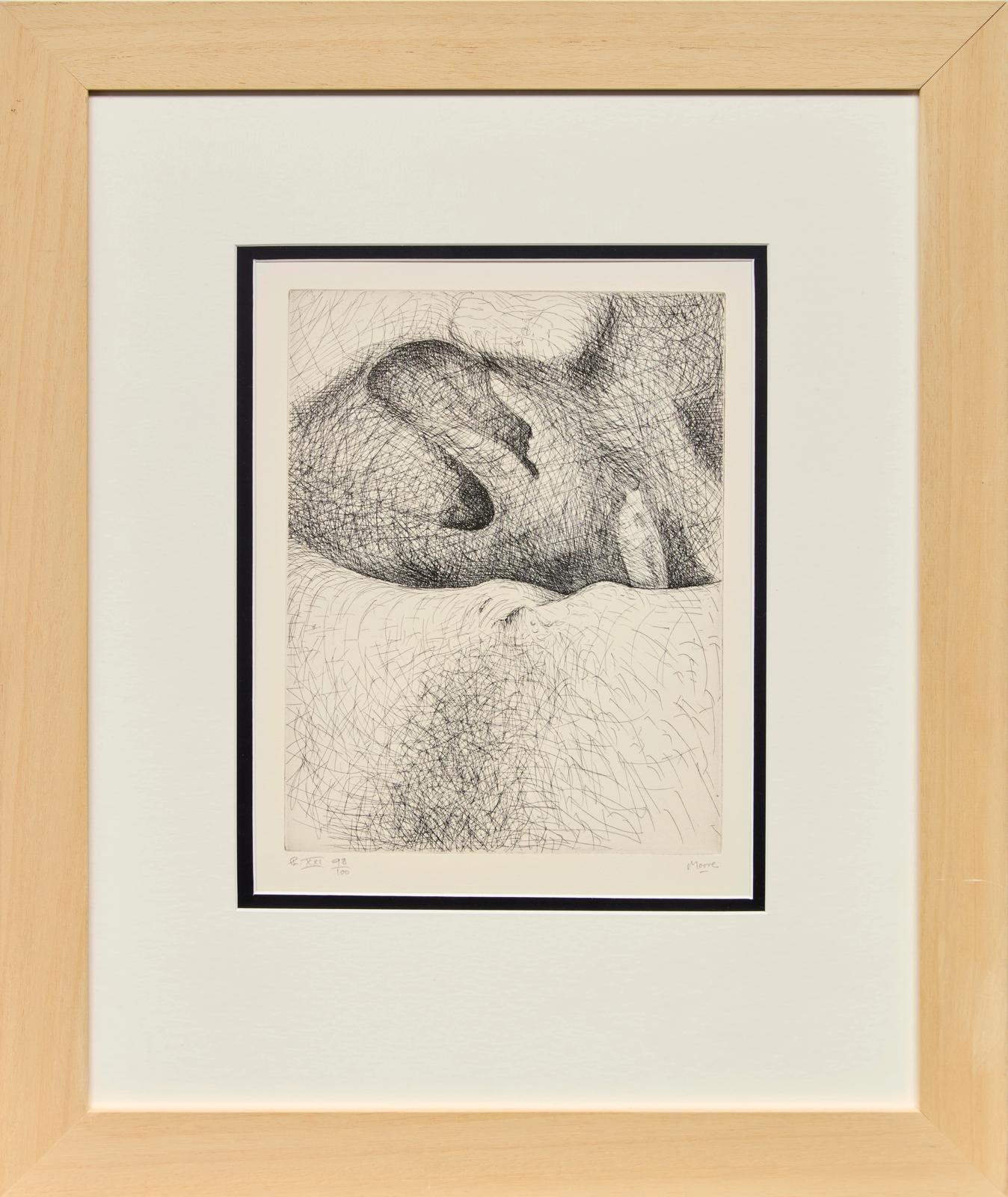
The magnified focus of plate XXI takes a classic Moore subject – organic matter – and gives it classic Moore treatment. Something part abstract emerges from a figurative study, and reveals a landscape-like image reminiscent of Moore's famous figures as landscapes.
Well proportioned and balanced compositionally, plate XXI arguably makes better use of the medium of drypoint etching than any other plate in the series, with delicate lines worked effortlessly into a rich and complex picture that conveys both the strongest and most delicate parts of the skull. It is a beautiful example of Moore’s etchings, and evidence of his position as one of the twentieth century’s greatest practitioners of the medium.
Notes:
Cramer 134
Etching and dry point in black
On Rives paper
Signed in pencil, dated and numbered 93/100
Printed by Atelier Lacourière et Frélaut, Paris
Published by Gérald Cramer, Geneva
Moore's caption to print: "I used the hairlike fineness of line to suggest space and mystery"
.jpeg)